Built for women, by women

Built for women, by women

Founded on the belief that every woman deserves better than guesswork about her body.

Founded on the belief that every woman deserves better than guesswork about her body.

Founded on the belief that every woman deserves better than guesswork about her body.

The founding moment

Phira emerged from a simple but powerful frustration: in a world powered by real-time intelligence, women are still left with hindsight, not insight.

Phira emerged from a simple but powerful frustration: in a world powered by real-time intelligence, women are still left with hindsight, not insight.

Most women discover, at some point, that the tools available to them for understanding their own bodies are surprisingly primitive. Our options include calendar apps that are based completely on guesswork, daily temperature readings that can only confirm what has already happened, or urine tests that are too burdensome for tracking cycle over cycle.

For women with imbalances, the answer from the medical system is often to suppress the cycle entirely rather than understand it. For women trying to conceive, today's fertile window trackers are based on guesswork or late indicators rather than real-time biological events. For women who simply want to understand how their hormones affect the way they feel, sleep, train, and think, the tools don't exist.

Most women discover, at some point, that the tools available to them for understanding their own bodies are surprisingly primitive. Our options include calendar apps that are based completely on guesswork, daily temperature readings that can only confirm what has already happened, or urine tests that are too burdensome for tracking cycle over cycle.

For women with imbalances, the answer from the medical system is often to suppress the cycle entirely rather than understand it. For women trying to conceive, today's fertile window trackers are based on guesswork or late indicators rather than real-time biological events. For women who simply want to understand how their hormones affect the way they feel, sleep, train, and think, the tools don't exist.

Woman smiling, representing Phira's mission for women's hormonal health

Our mission

Our mission is for every woman to be able to understand her own body, from first period to menopause. That information should be accessible enough to fit real life, and precise enough to be actionable in ways that matter deeply.

Our mission is for every woman to be able to understand her own body, from first period to menopause. That information should be accessible enough to fit real life, and precise enough to be actionable in ways that matter deeply.

So every woman can make decisions that serve both who she is today and who she wants to be long-term.

So every woman can make decisions that serve both who she is today and who she wants to be long-term.

Dr. Alisha Menon, founder and CEO

About the founder

Dr. Alisha Menon, Founder and CEO of Aurelia Vitals, Inc., the company behind Phira, received her Ph.D. in Electrical Engineering and Computer Science from UC Berkeley, where she worked at the frontier of machine learning integrated with advanced wearable sensors. She is a National Science Foundation (NSF) Fellow, a UC Berkeley EECS Fellow, a Rice Biotech Launchpad Fellow, and has first-authored 9 peer-reviewed publications spanning physiological sensing, intelligent systems, and human-centered device design. Dr. Menon previously worked at CTRL-labs (acquired by Meta) and Apple, contributing to next-generation sensing technologies and seamless human-device interfaces.

"I wanted a tool that could tell me what my hormones were actually doing, and why. The information available to me was fragmented, retrospective, and never quite enough to act on. I could feel the gap in the way I trained, recovered, and made decisions about my body. Phira is designed for real, continuous insight into my own biology, in a way that fits my life."

Dr. Alisha Menon
Founder & CEO, Aurelia Vitals, Inc.
Ph.D. in Electrical Engineering & Computer Science, UC Berkeley

About the founder

Dr. Alisha Menon received her Ph.D. in Electrical Engineering and Computer Science from UC Berkeley, where she worked at the frontier of machine learning integrated with advanced wearable sensors. She is a National Science Foundation (NSF) Fellow, a UC Berkeley EECS Fellow, a Rice Biotech Launchpad Fellow, and has first-authored 9 peer-reviewed publications spanning physiological sensing, intelligent systems, and human-centered device design. She has previously worked at Apple and CTRL-labs, contributing to next-generation sensing technologies and seamless human-device interfaces.

"I wanted a tool that could tell me what my hormones were actually doing, and why. The information available to me was fragmented, retrospective, and never quite enough to act on. I could feel the gap in the way I trained, recovered, and made decisions about my body. Phira is designed for real, continuous insight into my own biology, in a way that fits my life."

Dr. Alisha Menon, Founder & CEO
Ph.D. Electrical Engineering & Computer Science, UC Berkeley

With support from

The Company Journey

Built in the Texas Medical Center.

Grounded in science

We built the first version of Phira in early 2025, and from there, we started learning what the signals could actually tell us about the menstrual cycle. As we collected more data, we began seeing patterns that pointed to underlying hormone dynamics. That eventually grew into an IRB-approved pilot study, which wrapped in early 2026 and gave us the foundational data for our hormone tracking work.

With support from the National Science Foundation, early backing from Rice University’s Liu Idea Lab for Innovation & Entrepreneurship as well as Rice Biotech Launchpad, and research funding with collaboration from Baylor College of Medicine, Phira is grounded in rigorous science and clinical collaboration. The company is operating from dedicated lab facilities within the Texas Medical Center, the largest medical center in the world.
Under its parent company, Aurelia Vitals, Inc., Phira has grown from an idea into a wearable platform being built from the science up with support from the National Science Foundation, early backing through the Rice Biotech Launchpad, research funding with close collaboration from leading medical institutions Baylor College of Medicine and Texas Children’s Hospital Pavilion for Women, and dedicated lab facilities at Texas Medical Center Innovation Factory, one of the largest medical centers in the world.

That foundation allowed us to move from the lab into a real-world multi-month study, generating the longitudinal data behind our hormone modeling. Today, Phira is building the first hormonal health operating system for women, because women deserve tools as sophisticated as the biology they're designed to support.

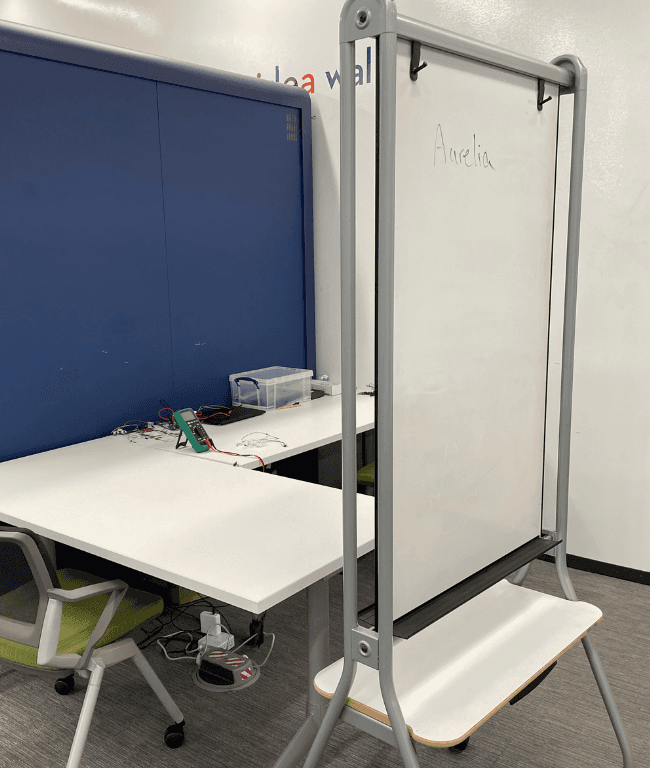
  • Early incubator office space
  • Research lab at Texas Medical Center Innovation Factory
  • Start of Phira's IRB-approved pilot study with participants
  • Early Phira prototype worn behind the ear during pilot study
  • Current Phira earring-back wearable worn behind the ear

Be part of what we're building.

Be part of what we're building.

We're at an early and exciting stage expanding our research, refining our platform, and building a community of women who believe the same thing we do: that your hormonal health deserves better tools.

We're at an early and exciting stage expanding our research, refining our platform, and building a community of women who believe the same thing we do: that your hormonal health deserves better tools.